
When missiles fly in this region, they are never just aimed at military targets.

'I suspect that Bangladesh being given permission stuck in India's official craw, and this story was an attempt to balance the scales by giving the impression that a similar waiver had been given to India as well.'

The question is no longer whether the war will expand. It has. The next few days will tell us whether the war stabilises around Hormuz or whether the Strait itself becomes the trigger for a far larger rupture. What to watch for over the next 48 hours is simple: Any move by the US toward direct naval control of the Strait; any credible Iranian attempt to disrupt or mine shipping lanes and, critically, whether energy infrastructure in the Gulf continues to be targeted.If those lines are crossed in tandem, the war will no longer be containable within the region.

President Trump asserts the US military has decimated Iran's forces and no longer requires assistance from NATO allies to secure the Strait of Hormuz, despite earlier requests for support.

Iran is fighting a different war: Older, slower, and in some ways more dangerous. Iran doesn't need to shoot down an F/A-18. It only needs to make the Strait of Hormuz feel dangerous long enough for insurance markets, shipping companies, and oil futures traders to do the rest. Prem Panicker continues his must-read daily blog on the war in the Middle East.

Citizens and residents across the Gulf region are preparing for Eid amidst regional conflict, impacting festivities and daily life.

Israel has for more than two decades and several US presidencies worked to draw the United States into a full-scale war with Iran. Having finally achieved that, the last thing it wants is Trump declaring victory and going home, as he is prone to do. Ali Larijani was the figure most capable of handing Trump a negotiated exit with something to show for it. Without Larijani, the road to an exit gets considerably narrower. Prem Panicker continues his must read daily blog on the Gulf War.

Fight on toward goals that keep receding, or exit with most objectives unmet. Trump is agitated, his poll numbers falling below the Plimsoll line, his base fractured between those who back the war and those who remember that he campaigned on ending them.

For weeks, the war skirted the edge of catastrophe without tipping over. Missiles flew, there was much destruction, commanders were assassinated, cities across the Gulf and even in Israel struggled to absorb the shock. But one line held: Energy infrastructure, the arteries of the global economy, remained largely untouched. That is no longer true. Prem Panicker continues his must read daily blog on the Gulf War.

Alliances fight wars effectively only when they share an endgame. If Israel acted without US knowledge, then the military alliance is operating without real coordination at the level of strategic targeting. Neither picture is reassuring in a war that is no longer regional in its consequences. Prem Panicker continues his must read daily blog on the Gulf War.

'Was the five-day pause ever meant to hold, or was it simply another instrument of signaling, of positioning, of buying time in a war where even the pauses are tactical?' asks Prem Panicker in his must read daily blog on the Gulf War.

The pause gives the US time to breathe, to regroup, to move its expeditionary force into position without risk of interception along the way. It gives Iran nothing -- on the ground, attacks against its infrastructure continue apace. Prem Panicker in his must read daily blog on the Gulf War.

The ongoing conflict involving the United States, Israel, and Iran intensified sharply with attacks on critical energy infrastructure across the Gulf, even as US President Donald Trump said he had cautioned Israeli Prime Minister Benjamin Netanyahu against targeting Iran's key South Pars Gas Field.

What we are watching is something different: A fog manufactured and maintained by the people who started the war, so that the question of why it was started never has to be answered, observes Prem Panicker in his must read blog on the war in the Middle East.

When everyone has footage and no one can verify it, the loudest voice wins, notes Prem Panicker who begins a daily blog on the War in the Middle East.

Sensex and Nifty post steepest weekly loss in over a year, falling nearly 3 per cent.
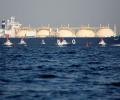
Oil and LNG prices are likely to shoot up if Iran is to block Strait of Hormuz, through which countries like India import crude oil from Saudi Arabia, Iraq and UAE, leading to a spike in inflation, analysts said on the Iran-Israel conflict. The Iran and Israel conflict has escalated over the last few days. Iran first launched drone and rocket attacks on Israel, which retaliated by firing a missile. Crude oil prices have hovered around USD 90 per barrel since the conflict.

'If the almost literally heart-stopping Suez block has any positive outcome, it is to be hoped that it will accelerate the setting up of a fab (perhaps Taiwanese) in India,' asserts Rajeev Srinivasan.

'The bigger challenge and dilemma for Pakistan would be if the US and Saudi Arabia go full throttle against Iran and enforce regime change in Tehran.' 'That would be bad news for Pakistan, especially with the current instability in Balochistan,' notes Brigadier Narender Kumar (retd).
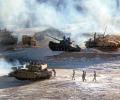
India's national security strategy needs to be revised periodically since the global and regional geopolitical situation is dynamic, points out Commodore Venugopal Menon (retd).
 © 2026 Rediff.com - Advertise with us - Disclaimer - Privacy Policy - Sitemap - Feedback - About us - Terms of use - Grievances